
Crucifixion Tuesday – Summary

The Tuesday Before the Crucifixion

This is a summary (for the sidebar menu) of a series of posts on “Passion Tuesday” — the Tuesday before our Lord’s crucifixion.

Why “Passion Week”? — Explaining why Christians use the term “Passion Week” and why I’m saying “Passion Tuesday.”  (A later article in the series, but seemed to fit best at the beginning of the summary.)

“Whose is This Image and Superscription?” — A coin in the British Museum shows clearly that the coin the Pharisees and Herodians brought to Jesus was an idolatrous coin, and Jesus used this fact to reveal their hypocrisy.  (This article is also part of the “Bible in the British Museum” series.)

Misusing Matthew 22:21: “Render Unto Caesar” — Too often, modern applications of this passage miss the point.  “As so often, when you ask the Lord a question, the answer turns out to be a claim on your life.”

“By What Authority?” — The Claims of Messiah — The first question of the day came from the chief priests and elders, the religious authorities.  This post looks at the Messianic claims and actions of Jesus, the background to their question.  They asked who gave Him the right to do these things, which only Messiah could legitimately do.

“By What Authority?” — Jesus Answers the Question — Their question was appropriate, and the idea that Jesus used a trick to dodge it is wrong.  “Jesus answered their question, but His answer revealed that they had asked the wrong question. Their real problem, their real question, was not about authority at all — it was unbelief.”

Matthew 21:28-32 — The Parable of the Two Sons — In the “By What Authority” question, the leaders of the Jews had challenged Jesus on the basis of a passage in Malachi 3.  Jesus answered in keeping with that passage.  Then, He told a parable which drew on the very same Old Testament chapter and book to rebuke and warn them over their disobedience to the Father.

The Parable of the Husbandmen — to Kill the Son — The Old Testament background of this parable, with the recent events before this interaction, sheds more light on the parable — and “the spirit of the chief priests and scribes lives on today.”

The Parable of the Husbandmen — the Chief Cornerstone — Again, Jesus quotes the Old Testament, showing that even the unbelief of the Jewish leaders was prophesied, yet another proof of His identity as the Messiah.  And the prophecy was in exactly the same Psalm which prophesied the words of praise from two days before (Palm Sunday).

The Withered Fig Tree — the Old Testament Symbolism — “As usual, when we want to understand something in the earthly life of our Saviour, it is a good idea to start by looking at the Old Testament.”

The Withered Fig Tree — One Year Before — To understand why Jesus cursed the fig tree, we need to not only recognise the Old Testament symbolism of the fig tree, we also need to look back to a parable Jesus had taught one year before — involving a fig tree.

The Withered Fig Tree — Nothing But Leaves — A basic understanding of breba figs ends a lot of confusion about this event.  When we connect the Old Testament symbolism, the earlier parable, and fig fruit cycles, the meaning of this “living parable” is clear.

The Son’s Wedding Feast — A Year Before — On “Passion Tuesday,” after applying the prophecy of the chief cornerstone to tell of the unbelief of the Jews, Jesus told another parable.  This parable expanded upon and applied another parable He had taught one year earlier, warning of the judgment to come on those who rejected Him.

The Son’s Wedding Feast — and Jewish Fables — A further look at this parable and how Jesus adapted two stories from the Jewish rabbis, changing them to refute their error and teach the truth.

Jesus, the Sadducees, and the Resurrection — When we understand the doctrinal errors of the Sadducees, the full force of Jesus’ answer to them comes clear.  This answer was the beginning of the end for the entire sect, as their follies were put fully on display.  Yet, many today persist in similar errors.

The Greatest Commandment — The last question from the Jewish leaders to the Saviour, on which was the greatest commandment of the Law.  This post is the first half of the article on this question and Jesus’ response.

The Second Great Commandment — The second half of the article on the final question to Jesus, discussing how He used this to show clearly the full demands of the Law, and the need for a Saviour.

Christ — “Whose Son is He?” — After answering all the questions of the religious leaders, Jesus asks them a question of His own, one that challenges their misconceptions about Messiah, and emphasises the Scriptural prophecy behind His earlier parable.

“The Common People Heard Him Gladly” — But where were they a day or two later?
Posted in Blog Housekeeping | 2 Comments

“Worthy” and “Love” — Two Different Languages

Expanding slightly today on a brief thought from yesterday’s message, which touched on Jesus’ parable of the Prodigal Son.  We join the story when the father and son meet as the son returns, from a rebellious and decadent life, to the place where he is loved:

Luke 15:21

And the son said unto him, Father, I have sinned against heaven, and in thy sight, and am no more worthy to be called thy son.

The son was right, he wasn’t worthy — but he wasn’t speaking the right language, and the father didn’t even answer him.  The father cared about one thing — he loved his son.

Luke 15:22-24

22 But the father said to his servants, Bring forth the best robe, and put it on him; and put a ring on his hand, and shoes on his feet:
23 And bring hither the fatted calf, and kill it; and let us eat, and be merry:
24 For this my son was dead, and is alive again; he was lost, and is found.

The son might speak words of worthiness, but the father spoke the language of love.  They aren’t in the same language, not in the same realm, barely even the same universe.

You don’t have to be worthy to be loved, you just have to be — loved.  Love’s existence lies not with the one who is loved, but with the one who is loving.

Trying to approach God on the basis of worth?  He’d like to change the conversation, to use a different language, to speak in terms of loving you as His child.

John 1:12

But as many as received him, to them gave he power to become the sons of God, even to them that believe on his name:

Posted in Grace and Forgiveness | Tagged , , | Leave a comment

Why Does the BBC Do This To Me?

As a child, I liked fire engines.  They went to help people in need.  If we heard a siren, I wanted to see them go by.  When they had open house at the fire station, I wanted to go.  But as I mentioned in a sermon a week or two ago, I had nightmares about fire engines.  They would chase me, and I could never get away.

Now, from the BBC:  Regular nightmares in childhood may be an early warning sign of psychotic disorders.  Thanks.  Now, my kids will probably never let me hear the end of it. 🙂

If I’d known this was coming, I could have used something different to illustrate my point!

Posted in Just for Fun | Tagged , | 6 Comments

“Fixing” Ephesians 4:28

God’s version:

Ephesians 4:28

Let him that stole steal no more: but rather let him labour, working with his hands the thing which is good, that he may have to give to him that needeth.

What many modern Christians practice:

Let him that stole steal no more:  but rather let him labour, working with his hands the thing which is good lobby the government for “needy causes”, that he may have to give to him that needeth feel compassionate — without actually giving or getting involved with individuals enough to know what help they really need.

Even if the “needy causes” are legitimate (and unfortunately they sometimes aren’t), when modern Christians outsource compassion and generosity to government, we:

  • Often diminish our own generosity
  • Make government the arbiter (often a poor one) of who gets help
  • Give government the right to pry into people’s lives to make that decision
  • Teach a generation to view government (not God) as the provider
  • Turn generosity into someone else’s responsibility (since most money the government takes for this purpose will be from other people, and not from me)
  • Turn generosity into simply “giving money” when that is often not the best way to help

All this damages our own view (and that of other believers) of what generosity and compassion is supposed to be — and then government goes and makes a mess of it, because they can’t possibly do this well.  How could they?  The decision-makers are rarely spiritually minded, are often motivated by their own desire for power, and don’t even know the people they are supposed to be helping….

Posted in Thoughts on the News | Tagged , , | 2 Comments

Tartan and Rabsaris and Rabshakeh

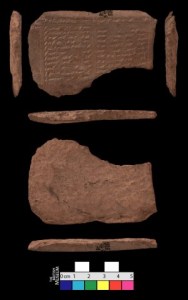
Eponym tablet

© Trustees of the British Museum

That title sounds like a rock band, doesn’t it? 🙂 Who are these guys, anyway?

The Bible says Sennacharib, the king of Assyria, sent “Tartan and Rabsaris and Rabshakeh” with an army against Jerusalem, but none of the ancient historians mentioned any such individuals.  (In fact, the ancient classical historians knew little of Nineveh, the Assyrian capital in Sennacherib’s time, either.)

It wasn’t until another “rock band” (the kind that digs among the rocks for ancient artefacts) took a hand that we learned the identity of these three men.  It ended a lot of confusion, including among Bible commentators, and (once again) archaeologists found evidence which backed up Biblical history.

Continue reading

Posted in Bible in British Museum | Tagged , , , , | 7 Comments

A Proverb for Today — Proverbs 18:12

“Before destruction the heart of man is haughty, and before honour is humility” (Proverbs 18:12).

As I read this Proverb this morning, it struck me that there are many ways that haughtiness, pride, can bring destruction.

Continue reading

Posted in A Proverb for Today | Tagged , , , | 2 Comments

“Not with Eyeservice, as Menpleasers”

This evening, a brief thought from this morning’s sermon.

Most employees would never think of stealing even two pence from their employer.  Why do they not even hesitate to steal two (or twenty) minutes that they should be working, by taking a longer than permitted break, or surfing the ‘Net, or whatever?  Why do even Christians do this?

It is a failure of integrity driven by an “eyeservice” / “menpleasing” mindset.  If my supervisor isn’t looking, I can get away with it….

Ephesians 6:5-6

5 Servants, be obedient to them that are your masters according to the flesh, with fear and trembling, in singleness of your heart, as unto Christ;
6 Not with eyeservice, as menpleasers; but as the servants of Christ, doing the will of God from the heart;

Posted in Daily Christianity, Quick Thoughts | Tagged , , | 4 Comments